How to Find Forging Companies for Aerospace, Automotive, and Industrial Parts
Finding the right forging company is not just a matter of searching for a supplier and asking for a price. Forged parts are usually built for demanding applications, so the best supplier fit depends on the part material, geometry, production volume, quality requirements, post-forging operations, and the industry the part will serve. That is why this guide is written for both sides of the sourcing process. Buyers can use it to send better RFQs. Forging companies can use it to understand what buyers need to see before they trust a supplier enough to request a quote.
Why forging supplier fit matters
The Forging Industry Association defines forging as a process where metal is pressed, pounded, or squeezed under great pressure into high-strength parts, and it notes that the process is different from casting because the metal is not melted and poured into a mold. The Forging Industry Association also describes forging equipment such as hammers, presses, upsetters, and ring rollers.
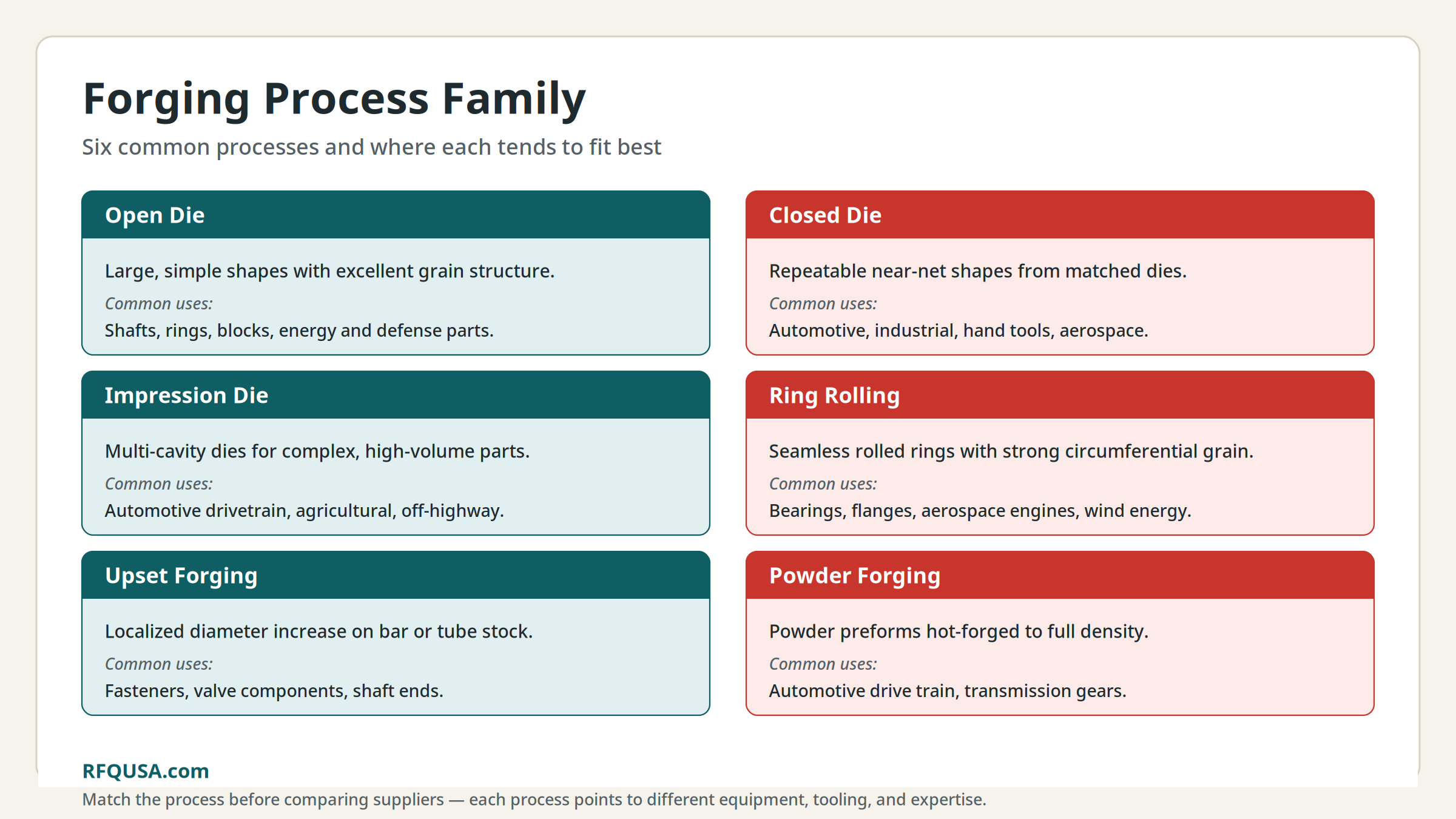
That distinction matters when a buyer is comparing suppliers. A company that is a good fit for a closed-die automotive component may not be the right fit for a large open-die aerospace part, a seamless rolled ring, or a short-run industrial replacement component. As Scot Forge puts it, “deciding between open-die and closed-die forging depends on several factors, including part size, complexity, production volume and budget.” Matching the process before comparing quotes prevents wasted cycles on both sides.
How manufacturing buyers actually find forging suppliers today
Buyer behavior has shifted. In a Forging Industry Association Member Voices interview, Laura Diedrich, marketing and communications manager at Scot Forge — one of the largest open-die and ring-rolled forging producers in North America — described how buyers reach her company:
“There’s quoting opportunities that come through the FIA website via their RFQ form. The networking opportunities within the industry is fantastic and just you have access to so much more information than you do as a standalone company.”
— Laura Diedrich, Scot Forge, FIA Member Voices
That online RFQ pipeline is the pattern forging companies should plan around. Machine shops, tier-two manufacturers, and OEM procurement teams are searching for a specific capability, material, or process, then contacting the shortlist of suppliers whose online information proves the fit. When those buyers cannot find clear process, material, and application information, they move on. When they can, both quote volume and quote quality tend to rise together.
Why RFQ quality matters as much as quote volume
Getting more inbound RFQs only helps a forging supplier if the RFQs are quotable. Writing in FIA Magazine, Danielle Smith, director of marketing administration and inside sales at Finkl Steel, made this point directly:
“Many times, a quotation fails to meet a customer’s needs because a clear understanding of what is required was not conveyed in the initial Request for Quote (RFQ). An RFQ that accurately details what is expected of the forging supplier will ultimately save you time and, in some cases, money.”
— Danielle Smith, Finkl Steel, in FIA Magazine
She adds that “complete RFQ packages eliminate the need for additional follow up questions and will help suppliers return quotations to you faster,” and that thorough RFQs “ensure a fair comparison is made between potential suppliers because everyone is working with the same supply criteria.”
The takeaway for both sides is the same. Buyers who send more complete RFQs get faster, more accurate quotes back — and comparable bids across suppliers. Forging companies whose online presence, RFQ form, and content clearly describe the processes, materials, and applications they support get better-matched inquiries in the first place. The more specifically a forger’s website and directory profiles describe what they actually forge, the more likely inbound RFQs match their capabilities and close.
Start with the part, not the supplier list
Before building a supplier shortlist, define what the part actually requires. A vague request for “a forging company” usually creates more work for the buyer and the manufacturer. A better RFQ narrows the search by process, material, size, volume, tolerances, and downstream requirements.
Key questions to ask before contacting forging companies
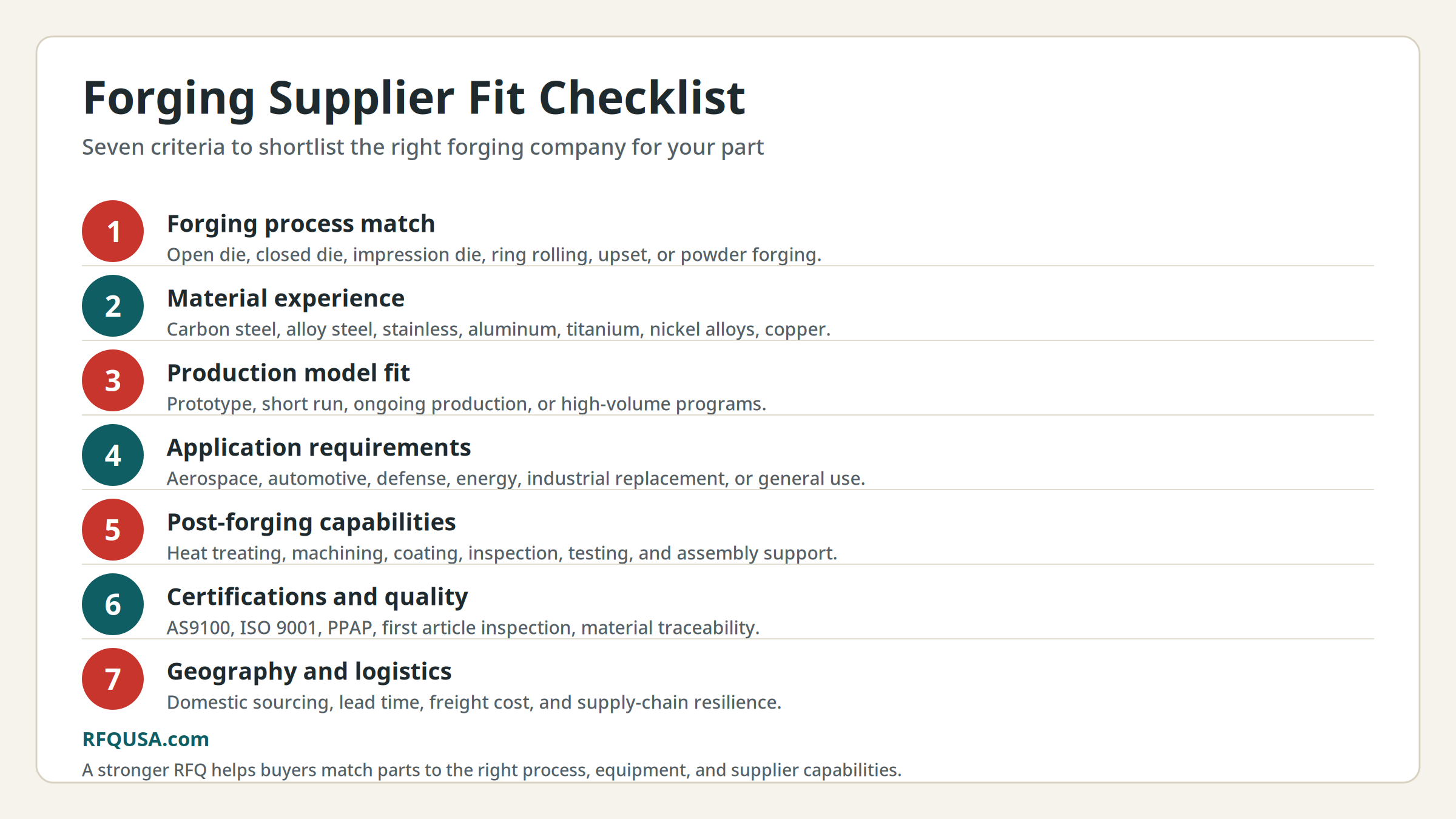
- What forging process does the part likely need? Open die, closed die, impression die, upset forging, ring rolling, and powder forging all point to different supplier capabilities.
- What material will be used? Carbon steel, alloy steel, stainless steel, aluminum, titanium, copper, brass, nickel alloys, and other high-temperature materials can change the supplier pool quickly.
- What is the production model? Prototype work, short runs, annual production, and high-volume programs each favor different shops.
- What happens after forging? Heat treating, machining, coating, testing, inspection, and assembly may be handled in-house or through qualified partners.
- What certifications or documentation are required? Aerospace, defense, automotive, and safety-critical parts often need more than a basic quote.
What buyers should include in a forging RFQ
A forging company can respond faster when the RFQ includes the details that affect process selection and risk. At minimum, include the drawing or model, material, estimated annual usage, target lead time, application, required standards, inspection needs, and any post-forging operations.
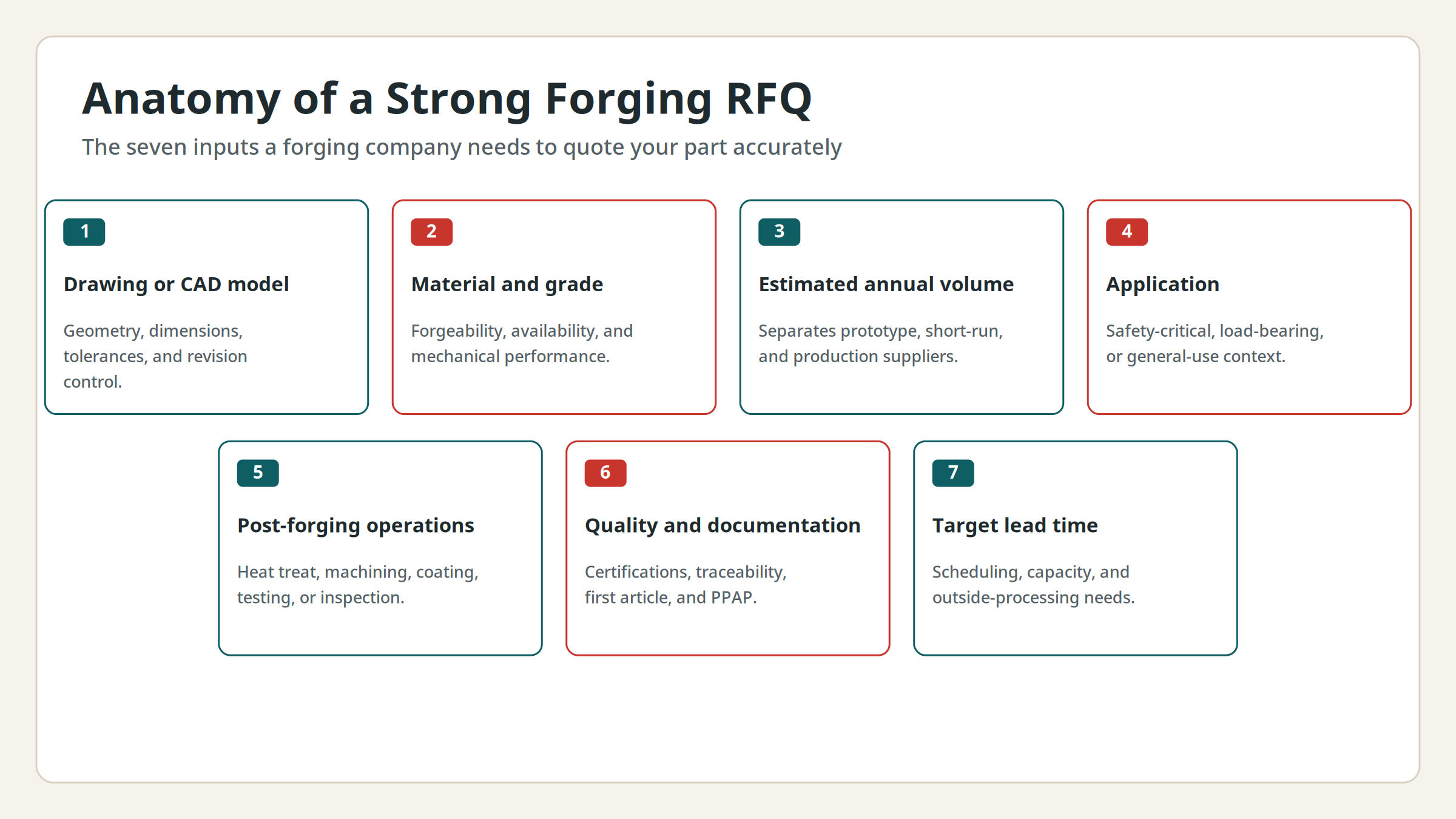
| RFQ detail | Why it matters |
|---|---|
| Part drawing or CAD model | Helps the supplier understand geometry, dimensions, tolerances, and revision control. |
| Material and grade | Determines forgeability, temperature requirements, availability, and mechanical expectations. |
| Volume | Separates prototype, short-run, and production supplier fits, and drives tooling economics. |
| Application | Signals whether the part is safety-critical, load-bearing, aerospace, automotive, industrial, or general use. |
| Post-forging operations | Clarifies whether the buyer needs machining, heat treat, coating, testing, or inspection support. |
| Quality requirements | Prevents quote gaps around certs, traceability, first article inspection, or customer-specific documentation. |
| Target lead time | Aligns scheduling, capacity, and outside-processing dependencies with the buyer’s program. |
Why process knowledge changes the quote
Forging quotes are shaped by more than raw material and press time. NIST material on forging and hot pressing emphasizes that successful powder forging depends on factors like preform design, material flow, tooling, heating, and production parameters. The NIST Materials Data Repository also describes powder forging as suited to high-production parts such as automotive drive train components and hand tools.
For buyers, that means the same part concept can lead to very different supplier recommendations depending on geometry, material, production volume, and required downstream operations. For manufacturers, it means a strong online profile should clearly explain what kinds of forged work the company is built to handle.
How to shortlist forging companies
- Match the process first. Do not treat all forging suppliers as interchangeable.
- Check material experience. A supplier’s experience with the right alloy can matter as much as its equipment list.
- Look for relevant markets served. Aerospace, automotive, defense, energy, and industrial replacement work may carry different expectations.
- Confirm secondary capabilities. Heat treating, machining, finishing, inspection, and testing can simplify the supply chain.
- Ask about documentation early. Certifications and traceability should be part of the quote conversation, not a surprise after supplier selection.
Flip the coin: what if you’re a forging company that wants to be found?
The same buyer behavior that helps procurement teams find suppliers is exactly what forging companies should design their online presence around. If your ideal customer is a tier-two manufacturer or a machine shop searching for a specific forging process and material, your website, directory listings, and content need to speak in the same specific language.
Concretely, that means:
- Name your processes and materials clearly. “Closed-die forgings in 4340 alloy steel” is easier to match to buyer intent than “custom forgings.”
- Show your application experience. Aerospace, defense, energy, automotive, and industrial replacement each carry different buyer expectations. Say which you serve.
- Document capacity, equipment, and certifications. Buyers who are quoting their own customers cannot afford to guess whether you can meet an AS9100, ISO 9001, PPAP, or first-article inspection requirement.
- Publish content buyers actually search for. Process comparisons, material selection guides, and application-specific pages help buyers self-qualify before they ever fill out an RFQ form.
- Make quoting easy. A short, well-designed RFQ form that captures the drawing, material, application, and volume tends to generate better inbound leads than a long questionnaire.
This is where RFQUSA and industry-focused associations fit into a forging company’s growth strategy. RFQUSA gives U.S. forging suppliers a verified profile inside a manufacturing directory that buyers and AI-powered sourcing tools are already searching. For casting-heavy shops that also want a niche-specific presence, The Casting Manufacturers Association (TCMA) is a good example of the direction industry associations are moving — a digital-first, sourcing-driven platform designed to help foundries win business, not just exist in a database. Forging manufacturers should look for the same pattern in the associations and directories they invest in: verified listings, capability-level pages, and content that AI search tools can cite when a buyer asks “who makes ring-rolled forgings in stainless.”
Guest content on RFQUSA is one of the most efficient ways for a manufacturer to publish authoritative, buyer-focused content on a domain buyers and AI tools already trust. It requires at least a premium membership tier — but as a way to publish authoritative content on a manufacturing-focused website that supports both traditional and AI search visibility, it is one of the most affordable options on the internet.
Where RFQUSA fits in
RFQUSA helps buyers find U.S. manufacturers by category, capability, location, and supplier profile. If you are sourcing forged parts, start with the RFQUSA forging company category and then compare related needs such as aerospace and defense manufacturing suppliers, CNC machining companies, and metal casting suppliers when the part could involve multiple processes.
If you are a forging manufacturer, this is the same buyer behavior your company profile should support. Buyers want to know what you forge, which materials you handle, which industries you serve, what secondary services you can support, and what kinds of RFQs are a good fit. A stronger RFQUSA profile can help your company be listed, found, and considered by buyers searching for U.S. forging suppliers.
Frequently asked questions
What is the difference between forging and casting?
Forging shapes metal under pressure without melting it, which produces high-strength parts with continuous grain flow. Casting melts metal and pours it into a mold. Both are widely used across manufacturing, but they serve different application, cost, and mechanical property requirements.
Which forging process is right for aerospace parts?
Aerospace parts are often produced by closed-die, impression-die, ring rolling, or open-die forging depending on geometry, alloy, and structural requirements. Aerospace forgings usually require material traceability, AS9100 certification, and documented inspection processes. Match the process to the part’s design intent and required certifications before shortlisting suppliers.
How can I compare U.S. forging suppliers?
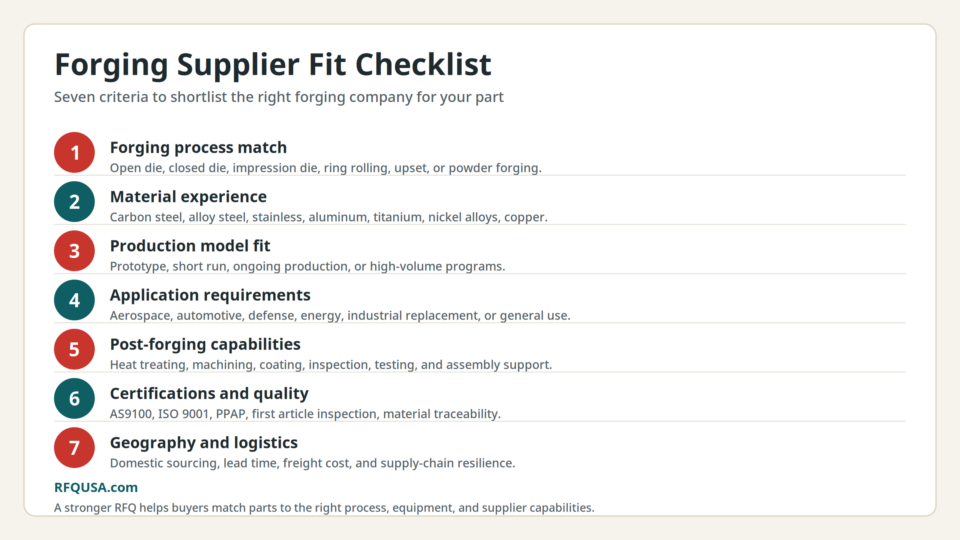
Compare process capabilities, material experience, production model fit, application experience, post-forging services, certifications, and geography. A directory like RFQUSA lets buyers filter by category and capability so the shortlist starts with suppliers that actually match the part.
What should I include in a forging RFQ?
Include the drawing or CAD model, material and grade, estimated annual volume, application, post-forging operations, quality and documentation requirements, and target lead time. Providing these seven inputs up front is the single biggest driver of quote accuracy and turnaround time.
Do I need to be a premium RFQUSA member to publish guest content?
Yes. Publishing guest content on RFQUSA requires at least a premium membership tier. For manufacturers that want to publish authoritative, buyer-focused content on a manufacturing site that already ranks in traditional and AI search, it is one of the most affordable options on the internet.
About the author: Nate Wheeler is the founder of Manufacturing Insiders and the digital marketing agency weCreate. He works with U.S. manufacturers on SEO, content, and demand generation, and hosts the Manufacturing Insiders podcast on how buyers, foundries, forges, and machine shops are actually connecting today.
Recent Posts
RFQUSA Recommends: ACHB Enterprise Co.
RFQUSA Top Cooling Tower Water Treatment Companies
Alternative Recruiting Strategies for Manufacturers: What to Do When Local Hiring Isn’t Enough