How Manufacturers Can Get More Visibility in AI Search
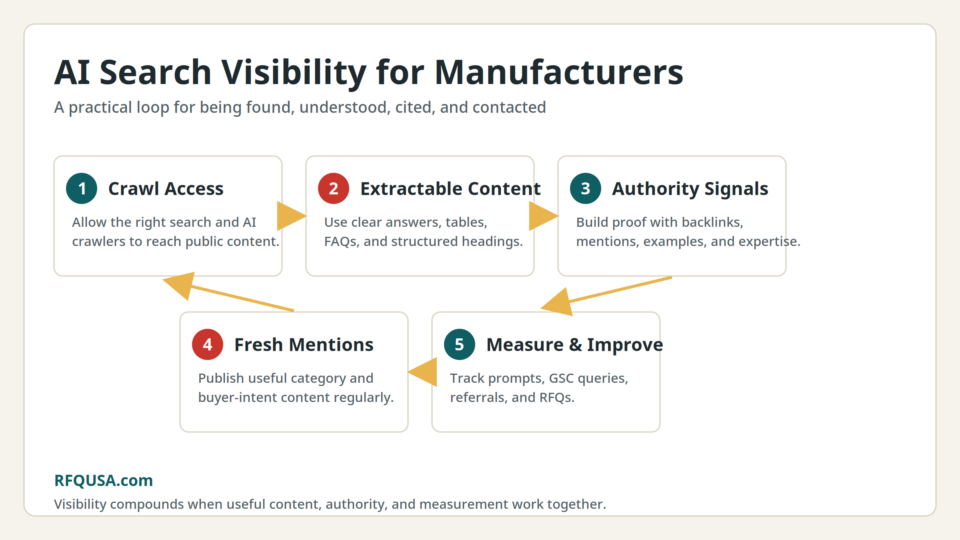
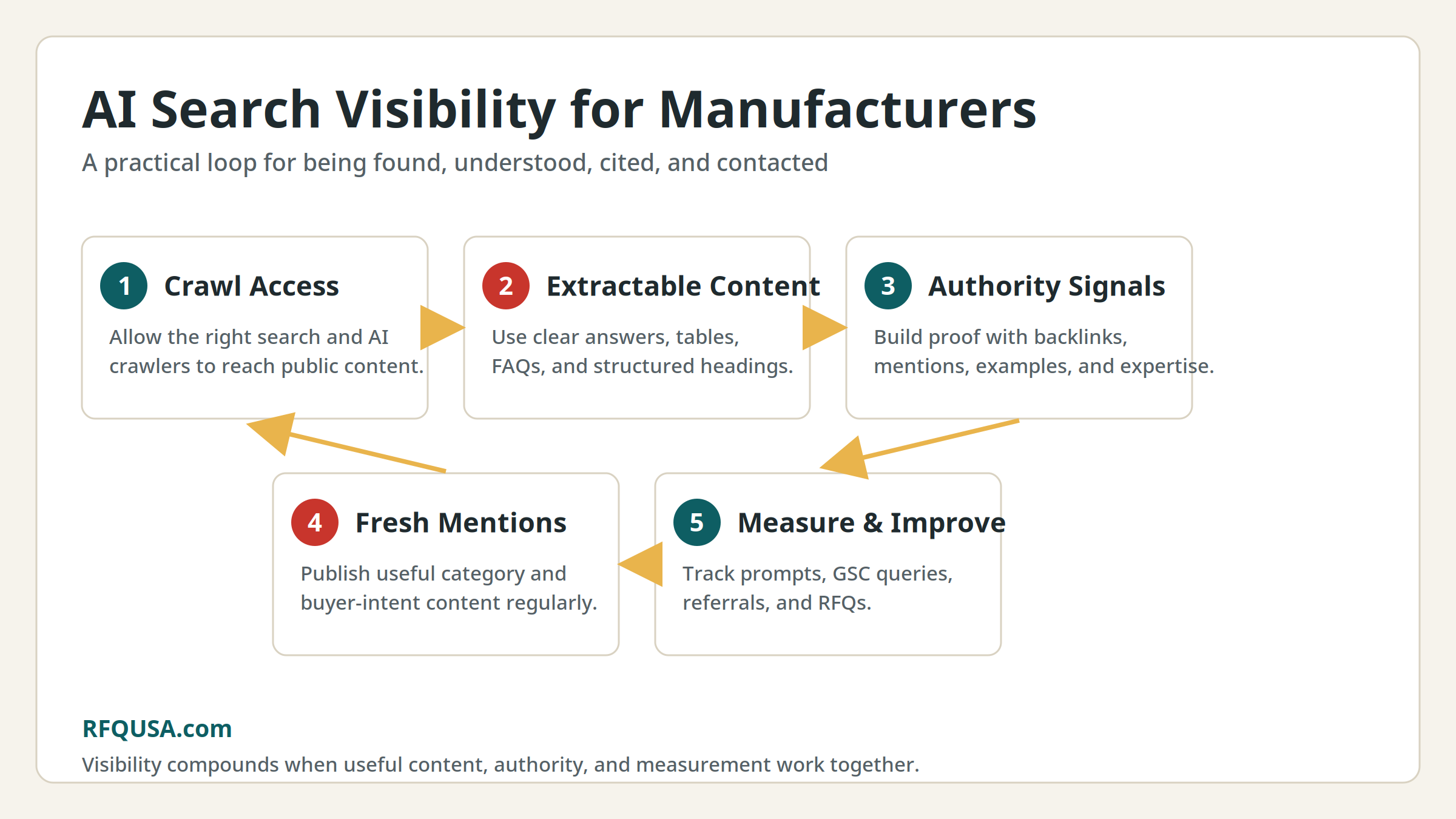
Manufacturers can get more visibility in AI search by making their expertise easy for search engines and AI platforms to crawl, understand, verify, and cite. The winning approach is not to chase every new acronym. It is to publish useful, structured, well-supported content that answers real buyer questions and gives AI systems clear reasons to trust the company behind the answer.
At RFQUSA, we see this shift from both sides of the manufacturing market. Buyers want faster ways to find capable suppliers, and manufacturers want more qualified RFQs without relying only on referrals, trade shows, or paid lead programs. AI search adds another layer to that challenge because platforms like Google AI Overviews, ChatGPT, Perplexity, Gemini, and Copilot are increasingly shaping which companies get discovered first.
Become a premium RFQUSA member to publish guest content
Publishing on RFQUSA is one of the most affordable ways on the web to place real manufacturing expertise on an authoritative industry site that both buyers and AI systems can find. Guest content requires at least the premium membership tier.
What AI search visibility means for manufacturers
AI search visibility means your company, category page, article, or directory listing can be found and used when an AI system answers a buyer’s question. A buyer might ask for the best U.S. machine shops for difficult-to-machine metals, how to find a custom rubber molder, which casting process fits a part, or how to compare domestic suppliers. If your company’s expertise is not clearly represented online, the AI system has less reason to include you in the answer.
This does not replace traditional SEO. It builds on it. Google says structured data helps Search understand page content by giving explicit clues about the meaning of the page, and the same principle applies to AI-assisted discovery: clear information is easier to interpret, summarize, and trust (Google Search Central structured data documentation).
Start with crawl access
Before an AI platform can cite or summarize your content, the right crawlers need to access it. Google’s crawler documentation explains that its common crawlers are used to find information for search indexes and other products, and that automated crawlers obey robots.txt rules (Google crawler documentation).
OpenAI also publishes crawler guidance. Its documentation says OAI-SearchBot is used to surface websites in ChatGPT search features, and that sites blocking it may not be shown in ChatGPT search answers, though they can still appear as navigational links (OpenAI crawler documentation). OpenAI’s publisher FAQ similarly recommends not blocking OAI-SearchBot if you want your content discovered, surfaced, cited, and linked in ChatGPT search (OpenAI publisher FAQ).
For manufacturers, this means your marketing team or web provider should periodically review robots.txt, noindex settings, blocked resources, and site security rules. A strong article cannot help if important content is accidentally hidden from the systems that need to evaluate it.
Make your expertise extractable
AI systems work best when the answer is not buried in a wall of text. Manufacturers should write pages that are useful for human buyers and easy for machines to parse. That usually means descriptive headings, short answer sections, comparison tables, FAQs, definitions, process lists, and clear examples.
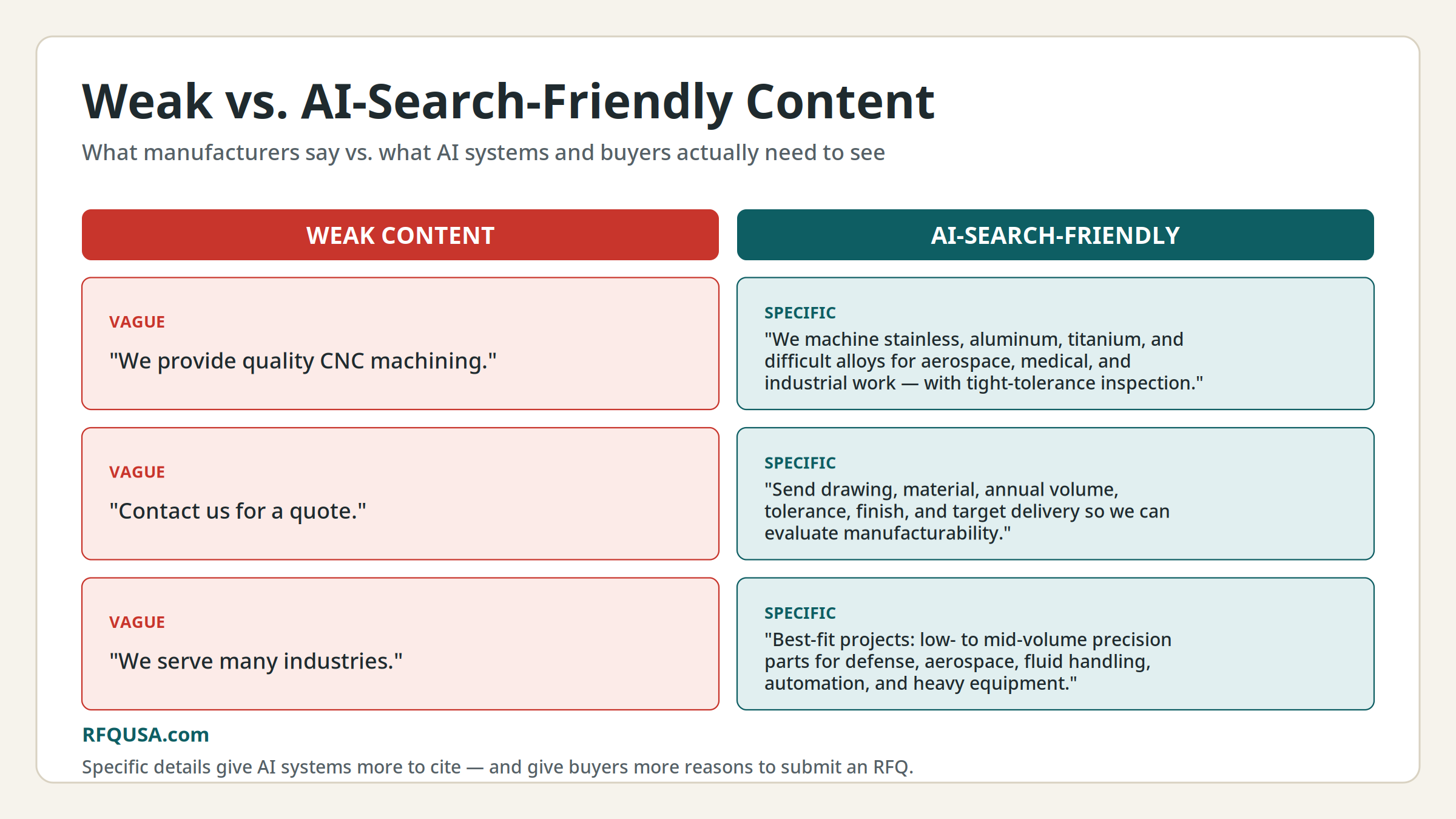
For example, a machine shop should not only say it provides CNC machining. It should explain the materials it handles, tolerance expectations, inspection capabilities, equipment types, lead-time considerations, industries served, and what makes a project a good or bad fit. A casting supplier should clarify alloy capabilities, casting methods, secondary operations, quality controls, and common failure points buyers should watch for.
Build authority around the topics buyers actually search
Manufacturers often publish thin service pages and stop there. That may be enough for a branded search, but it is rarely enough for AI search visibility. A stronger approach is to build topic clusters around the questions buyers ask before they submit an RFQ.
Examples include:
- How to choose a machine shop for difficult metals.
- When to use die casting instead of CNC machining.
- What to include in a manufacturing RFQ.
- How to compare U.S. fabrication suppliers.
- What makes a rubber molder qualified for custom components.
- How to avoid low-cost casting problems that create downstream scrap.
This is where directory inclusion and published content can work together. A manufacturer listed in a relevant RFQUSA category has another clear source describing what the company does. A contributed article, interview, supplier spotlight, or technical explanation can add more context around the company’s capabilities and expertise.
Use real experience, not generic marketing language
AI search creates a bigger penalty for vague content. If ten manufacturers say the same thing, none of them gives an AI system much to work with. Real experience is the differentiator.
Manufacturers should look for content ideas inside sales calls, customer questions, quote reviews, engineering discussions, trade show conversations, and production problem-solving. Those conversations often reveal the language buyers use and the details competitors forget to explain.
A recent example from the Manufacturing Insiders podcast: Connor Ouwinga, who leads Porous Pave — a manufacturer of a permeable pavement product made from recycled rubber and stone — framed his product’s positioning this way in a pre-interview conversation:
“Today isn’t really about what Porous Pave costs compared to concrete; it’s about how a ‘more expensive’ product can actually unlock millions in value if it’s solving the right problem.”
— Connor Ouwinga, Porous Pave
That is the kind of specific, honest framing an AI system can actually use. It is also the kind of language that helps a buyer trust the supplier before a call ever happens. Contrast that with a paragraph of generic “quality, service, and experience” copy — there is nothing in that boilerplate for an AI system to summarize, and nothing for a buyer to remember.
The same principle shows up across manufacturing categories. A sales manager at a national safety-products distributor might explain that the best leads come from a mix of referrals, distributor relationships, repeat quoting activity, and online proof that a supplier understands the buyer’s problem. A shop owner might explain that they turn down projects under a certain volume because the tooling economics do not work. Those specific, real-world details are what AI systems reward.
Strengthen the proof around your company
AI systems do not evaluate a single page in isolation. They look for corroborating signals across the web. Manufacturers can improve those signals by earning relevant backlinks, being listed in trusted directories, publishing useful explanations, keeping company data consistent, and getting mentioned in industry-specific contexts.
Strong proof can include:
- Directory listings in relevant manufacturing categories.
- Supplier spotlights or case-study-style articles.
- Trade association profiles.
- Customer stories or approved project examples.
- Technical articles that show process expertise.
- Backlinks from relevant industrial, regional, or association websites.
- Consistent company descriptions across the web.
For RFQUSA members, this is part of the value of being listed in a focused manufacturing environment. A listing is not just a backlink. It is another structured signal that helps buyers and search systems understand where the company fits. Guest articles — available to premium members — add a second signal in your own voice, with your own examples, on a site that both buyers and AI systems can crawl.
Measure AI search visibility differently than SEO
Traditional SEO still matters: rankings, impressions, clicks, and conversions should all be tracked. But AI search visibility needs extra measurement because users may see your company in an AI answer without clicking immediately.
Useful checks include:
- Prompting ChatGPT, Perplexity, Gemini, and Copilot with important buyer questions.
- Recording whether your company, RFQUSA listing, or article is mentioned.
- Tracking which competitors appear most often.
- Watching Google Search Console for new long-tail query impressions.
- Monitoring direct traffic, branded search, referral traffic, and RFQ form activity after new content is published.
- Refreshing articles when better examples, media, or source material becomes available.
A practical AI search visibility checklist for manufacturers
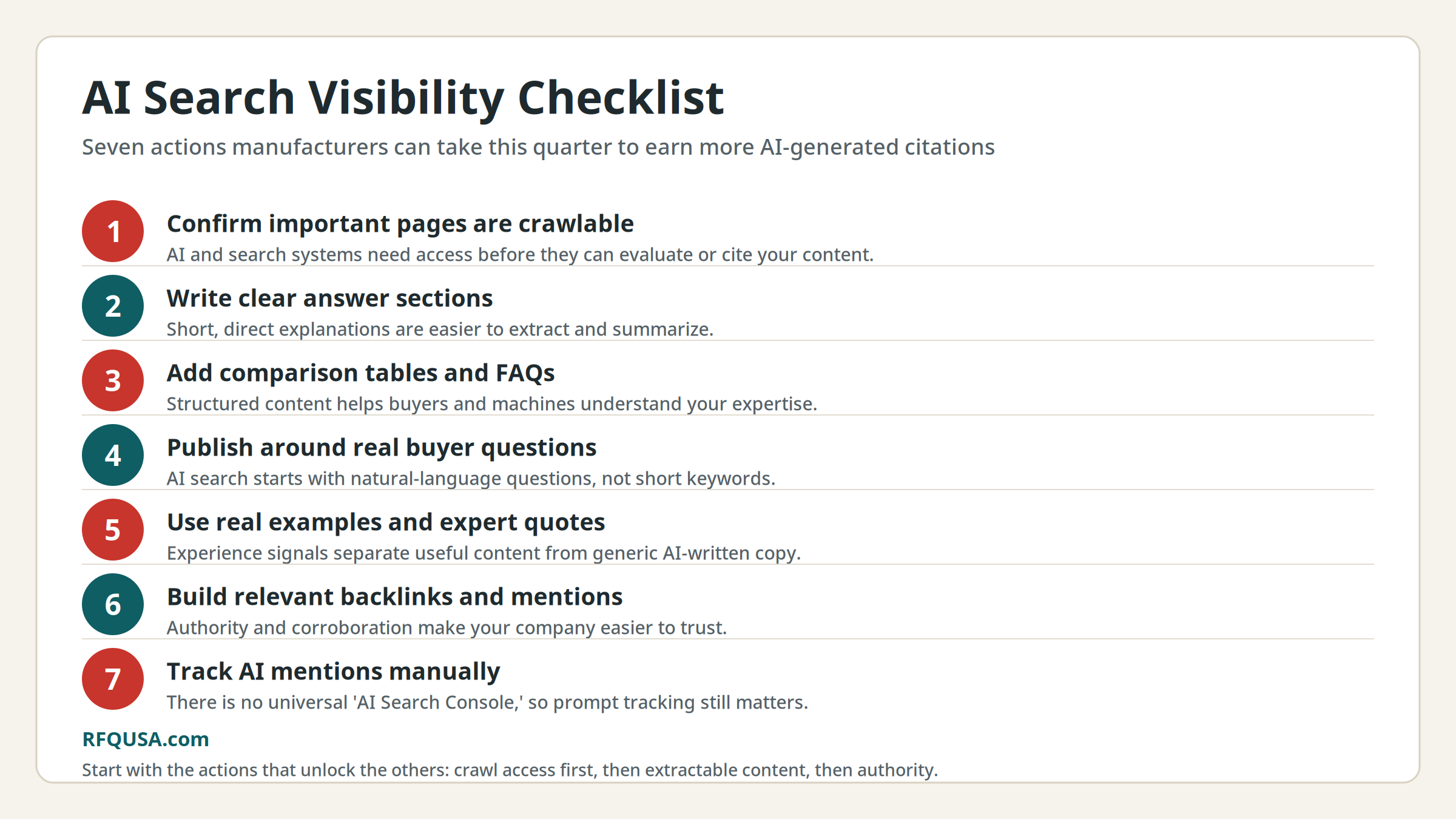
Where RFQUSA fits
RFQUSA is built to help buyers find qualified U.S. manufacturers and help manufacturers gain more relevant exposure. As AI search grows, that exposure becomes more valuable when it is supported by clear category pages, supplier listings, expert content, backlinks, and real manufacturing examples.
Guest content on RFQUSA is available to premium-tier members and above. Practically speaking, it is one of the least expensive opportunities on the web to place authoritative, buyer-facing manufacturing content on a site that both search engines and AI platforms already crawl. A single well-written guest article can keep working for a company for years — showing up in organic search, being cited by AI systems, and giving buyers a reason to reach out.
If your manufacturing company wants more visibility in organic search and AI-assisted discovery, start by making sure your expertise is clearly represented somewhere buyers and machines can understand it.
Sign up for premium to list your company and publish guest content
FAQs
Can manufacturers control whether they appear in AI search?
Not completely. AI platforms choose their own sources, but manufacturers can improve their chances by publishing crawlable, useful, structured, and trustworthy content that answers buyer questions clearly.
Is AI search visibility different from SEO?
Yes, but it depends on SEO fundamentals. Good technical SEO, helpful content, authority signals, structured data, and clear site organization all support both traditional search and AI-assisted discovery.
Should manufacturers block AI crawlers?
That depends on the content strategy. If the goal is broad visibility, manufacturers should be careful about blocking crawlers that are used for AI search discovery. If the content is proprietary, paid, or sensitive, crawler controls may be appropriate.
What type of manufacturing content works best for AI search?
Content that answers specific buyer questions tends to be more useful than generic service copy. Strong examples include supplier-selection guides, process comparisons, RFQ checklists, materials guides, troubleshooting articles, and expert interviews.
Do I need to be a member to publish a guest article on RFQUSA?
Yes. Guest content is available to premium-tier RFQUSA members and above. It is one of the most affordable ways to publish authoritative manufacturing content on a site that buyers and AI platforms already crawl.
About the author: This guide draws on conversations from the Manufacturing Insiders podcast, hosted by Nate Wheeler, where manufacturing leaders regularly discuss how buyers find suppliers, how suppliers earn trust, and how the industry is changing.
Recent Posts
RFQUSA Top Cooling Tower Water Treatment Companies

Alternative Recruiting Strategies for Manufacturers: What to Do When Local Hiring Isn’t Enough
How to Find the Best Casting Company for Aerospace, Automotive, and Industrial Parts